
















A-769662 is an activator of AMP-activated protein kinase[1], which has an EC50 value of 0.8μM[2]. A-769662 activated the activity of AMPK extracted from human embryonic kidney cells (HEKs) , rat muscle, or rat heart with EC50 values of 1.1mM , 1.9mM , or 2.2mM, respectively[3].
A-769662 ( 100μM , 36h ) activates AMPK signaling and tumor suppressor tuberous sclerosis complex 2 ( TSC2 ) phosphorylation[4]. A-769662 ( 100μM , 24h ) increased AMPK phosphorylation in normal rat kidney cells under normal glucose ( 5mM )[5].
A-769662 (400mg/mouse; 14 days; intraperitoneal injection) treatment reduced mouse colon tumor (CT26 mice tumor models) growth and resulted in long-term survivors[6]. A-769662 (20pmol, 3 days, intravitreal injection) protect mice from Methylglyoxal (MGO)-induced retinopathy[7].
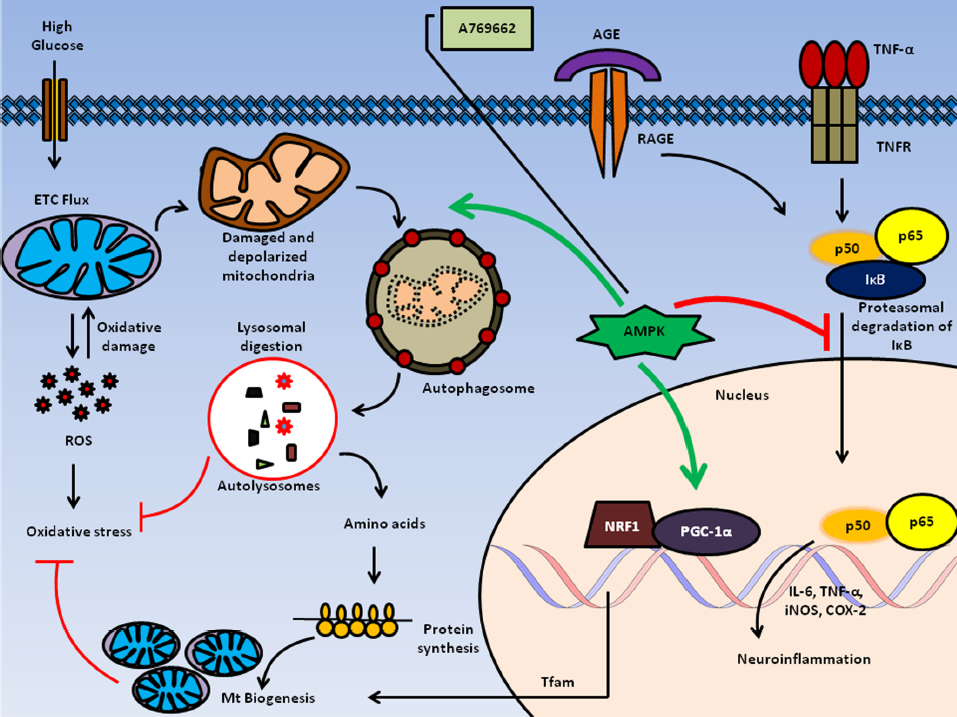
A-769662 promoting AMPK activation can induce the autophagy through facilitation of autophagosome formation[8] .
References:
[1] GORANSSON O, MCBRIDE A, HAWLEY S A, et al. Mechanism of action of A-769662, a valuable tool for activation of AMP-activated protein kinase [J]. J Biol Chem, 2007, 282(45): 32549-60.
[2] COOL B, ZINKER B, CHIOU W, et al. Identification and characterization of a small molecule AMPK activator that treats key components of type 2 diabetes and the metabolic syndrome [J]. Cell Metab, 2006, 3(6): 403-16.
[3] MORENO D, KNECHT E, VIOLLET B, et al. A769662, a novel activator of AMP-activated protein kinase, inhibits non-proteolytic components of the 26S proteasome by an AMPK-independent mechanism [J]. FEBS Lett, 2008, 582(17): 2650-4.
[4] KAKADIA J H, KHALID M U, HEINEMANN I U, et al. AMPK-mTORC1 pathway mediates hepatic IGFBP-1 phosphorylation in glucose deprivation: a potential molecular mechanism of hypoglycemia-induced impaired fetal growth [J]. J Mol Endocrinol, 2024, 72(3):
[5] SHRIKANTH C B, JAGANNATH S, CHILKUNDA N D. AMPK differentially alters sulphated glycosaminoglycans under normal and high glucose milieu in proximal tubular cells [J]. J Biochem, 2021, 169(1): 75-86.
[6] DAI X, BU X, GAO Y, et al. Energy status dictates PD-L1 protein abundance and anti-tumor immunity to enable checkpoint blockade [J]. Mol Cell, 2021, 81(11): 2317-31 e6.
[7] SEKAR P, HSIAO G, HSU S H, et al. Metformin inhibits methylglyoxal-induced retinal pigment epithelial cell death and retinopathy via AMPK-dependent mechanisms: Reversing mitochondrial dysfunction and upregulating glyoxalase 1 [J]. Redox Biol, 2023, 64(102786.
[8] YERRA V G, ARETI A, KUMAR A. Adenosine Monophosphate-Activated Protein Kinase Abates Hyperglycaemia-Induced Neuronal Injury in Experimental Models of Diabetic Neuropathy: Effects on Mitochondrial Biogenesis, Autophagy and Neuroinflammation [J]. Mol Neurobiol, 2017, 54(3): 2301-12.
A-769662是AMP活化蛋白激酶的激活剂[1],EC50值为0.8μM[2]。A-769662可激活人胚胎肾细胞(HEKs)、大鼠肌肉细胞和大鼠心脏细胞中提取的AMPK的活性,EC50值分别为1.1mM、1.9mM和2.2mM[3]。
A-769662(100μM,36h)能激活AMPK信号和促进肿瘤抑制因子结节硬化复合体2(TSC2)的磷酸化[4]。A-769662(100μM,24h)在标准葡萄糖浓度(5mM)下可提高健康大鼠肾细胞内的AMPK磷酸化水平[5]。
A-769662 (400mg/只;14天;腹腔注射治疗可抑制小鼠结肠癌(CT26小鼠肿瘤模型)的生长并延长小鼠存活[6]。A-769662(20pmol,3天,玻璃体内注射)保护小鼠免受甲基乙二醛(MGO)诱导的视网膜病变[7]。
A-769662上调AMPK激活可通过自噬体形成诱导自噬[8]。