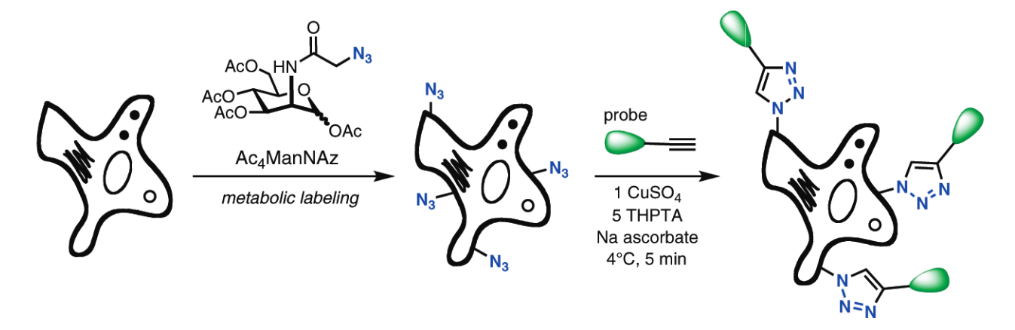
Trihydroxypropyl triazole amine (THPTA) is a water-soluble ligand[1]. In the presence of copper ions, THPTA ligand can be used for Cu2+-catalyzed alkyne-azide cyclization (CuAAC), and the formed copper complexes can accelerate the CuAAC process[2-3]. The CuAAC with the participation of THPTA ligand is not only suitable for the modification of hydrophilic polymers and biological coupling of polypeptides containing an azide group[4-5], but also for the rapid labeling of azide or alkyne labels absorbed by metabolic metabolism on the cell surface[6-7]. THPTA ligand can efficiently label living cells and maintain cell activity. Its labeling reaction usually takes only 15-30 minutes to complete at room temperature, and the ligand-CuSO4 complex can still maintain its original activity after at least one month of storage under freezing conditions.
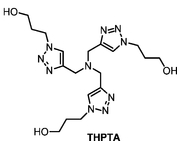
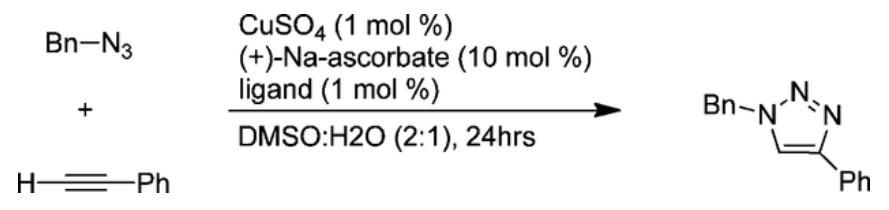
THPTA serves both to accelerate the CuAAC reaction and to protect the cells from damage by oxidative agents produced by the Cu-catalyzed reduction of oxygen by ascorbate in mammalian cells[7].
References:
[1]. Chan TR, Hilgraf R, et,al. Polytriazoles as copper(I)-stabilizing ligands in catalysis. Org Lett. 2004 Aug 19;6(17):2853-5. doi: 10.1021/ol0493094. PMID: 15330631.
[2]. Hong V, Presolski SI, et,al. Analysis and optimization of copper-catalyzed azide-alkyne cycloaddition for bioconjugation. Angew Chem Int Ed Engl. 2009;48(52):9879-83. doi: 10.1002/anie.200905087. PMID: 19943299; PMCID: PMC3410708.
[3]. Rao H, Tanpure AA, et,al. Enzymatic incorporation of an azide-modified UTP analog into oligoribonucleotides for post-transcriptional chemical functionalization. Nat Protoc. 2012 May 10;7(6):1097-112. doi: 10.1038/nprot.2012.046. PMID: 22576108.
[4]. Manzenrieder F, Luxenhofer R, et,al. Stabilization of virus-like particles with poly(2-oxazoline)s. Angew Chem Int Ed Engl. 2011 Mar 7;50(11):2601-5. doi: 10.1002/anie.201006134. Epub 2011 Jan 20. PMID: 21370346; PMCID: PMC3574789.
[5]. Kemal Arda Günay, et,al. Synthesis of cyclic peptide disulfide–PHPMA conjugates via sequential active ester aminolysis and CuAAC coupling11Electronic supplementary information (ESI) available. See DOI: 10.1039/c5py01817j,Polymer Chemistry,Volume 7, Issue 4,2016,Pages 970-978,ISSN 1759-9954,
[6]. Kennedy DC, et,al. Cellular consequences of copper complexes used to catalyze bioorthogonal click reactions. J Am Chem Soc. 2011 Nov 9;133(44):17993-8001. doi: 10.1021/ja2083027. Epub 2011 Oct 19. PMID: 21970470.
[7]. Hong V, Steinmetz NF, et,al. Labeling live cells by copper-catalyzed alkyne--azide click chemistry. Bioconjug Chem. 2010 Oct 20;21(10):1912-6. doi: 10.1021/bc100272z. PMID: 20886827; PMCID: PMC3014321.
三(3-羟丙基三唑甲基)胺(THPTA) ligand是一种水溶性配体[1]。在铜离子存在的条件下,THPTA ligand可用于Cu2+催化的炔烃-叠氮化物环化反应(CuAAC),并且形成的铜配合物可以加速CuAAC进程[2-3]。THPTA ligand的参与的CuAAC不仅适用于亲水性聚合物的修饰和含一个叠氮基的多肽的生物偶联[4-5],还可用于细胞表面代谢吸收的叠氮或炔烃标签的快速标记[6-7]。THPTA ligand 可以高效标记活细胞,并维持细胞活性。它的标记反应在室温下往往只需要15-30分钟即可完成,在冷冻条件下储存,配体-CuSO4 复合物在至少一个月后仍能保持原有的活性。