
















CB-5083 is a highly selective and orally bioavailable AAA-ATPase p97 inhibitor with an IC50 value of 11nM[1]. P97 is an enzyme involved in clearing misfolded proteins. CB-5083 binds to and inhibits p97 activity, leading to accumulation of ubiquitinated proteins, inducing prototoxic stress and activating apoptosis to exert anti-tumor activity (Fig 1)[2]. CB-5083 is commonly used as an anti-cancer agent in research on multiple myeloma and solid tumor models[3,4].
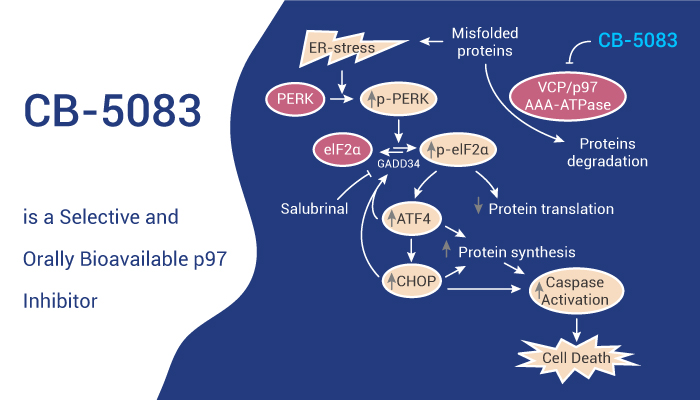
Fig 1. Mechanism of action of CB-5083[5,6]. CB-5083 specifically targets the Valosin-Containing Protein (VCP) p97. By inhibiting the ATPase activity of p97, CB-5083 blocks the ubiquitin-proteasome system and endoplasmic reticulum-associated protein degradation (ERAD), leading to the accumulation of misfolded and damaged proteins. This subsequently triggers the unfolded protein response and prototoxic stress, ultimately resulting in cancer cell death.
In vitro, treatment of myeloma RPMI8226 cells with CB-5083 (0.3125-20μM) for 8h induced expression of unfolded protein response (UPR) markers sXBP1 and BiP, and accumulation of K48 polyubiquitinated proteins[5]. Treatment of human osteosarcoma SJSA-1 and U2OS cells with CB-5083 (0.5, 1 μM) for 48h induced G1 phase cell cycle arrest and promoted apoptosis[7]. Treatment of THP-1 and MV4-11 cells with CB-5083 (200nM) for 6h altered the ubiquitin-modified proteome, including ubiquitination levels of Valosin-containing protein (VCP) itself, proteasome components, autophagy-related proteins, and DNA damage response factors[8].
In vivo, oral administration of CB-5083 (60mg/kg) to severe combined immunodeficiency disease (SCID) beige mice bearing RPMI8226 xenografts resulted in plasma levels of CB-5083 within 2-20μM over 24h, sustained significant K48 polyubiquitinated protein accumulation, activated UPR, and increased CHOP protein expression by 2.7-fold compared to baseline[5]. Oral gavage of CB-5083 (15mg/kg) to 2-month-old VCPR155H/R155H homozygous mice for 5 months was well tolerated, with steady body weight gain and normal organ weights, did not increase liver enzymes (such as aspartate aminotransferase (AST) and alanine aminotransferase (ALT)), and significantly reduced AST levels[9].
References:
[1] ZHOU H J, WANG J, YAO B, et al. Discovery of a first-in-class, potent, selective, and orally bioavailable inhibitor of the p97 AAA ATPase (CB-5083)[J]. 2015.
[2] ANDERSON D J, LE MOIGNE R, DJAKOVIC S, et al. Targeting the AAA ATPase p97 as an approach to treat cancer through disruption of protein homeostasis[J]. Cancer Cell, 2015, 28(5): 653-665.
[3] LEBLANC A K, MAZCKO C N, FAN T M, et al. Comparative oncology assessment of a novel inhibitor of valosin-containing protein in tumor-bearing dogs[J]. Molecular Cancer Therapeutics, 2022, 21(10): 1510-1523.
[4] WANG F, LI S, HOUERBI N, et al. Temporal proteomics reveal specific cell cycle oncoprotein downregulation by p97/VCP inhibition[J]. Cell Chemical Biology, 2022, 29(3): 517-529.
[5] LE MOIGNE R, AFTAB B T, DJAKOVIC S, et al. The p97 inhibitor CB-5083 is a unique disrupter of protein homeostasis in models of multiple myeloma[J]. Molecular Cancer Therapeutics, 2017, 16(11): 2375-2386.
[6] CB-5083 is a selective and orally bioavailable p97 inhibitor[EB/OL]. (2020-12-17) [2025-10-02]. https://www.immune-system-research.com/2020/12/17/cb-5083-is-a-selective-and-orally-bioavailable-p97-inhibitor/.
[7] ZHAO Z, WU M, ZHANG X, et al. CB-5083, an inhibitor of P97, suppresses osteosarcoma growth and stem cell properties by altering protein homeostasis[J]. American Journal of Translational Research, 2020, 12(6): 2956.
[8] SZCZĘŚNIAK P P, HEIDELBERGER J B, SERVE H, et al. VCP inhibition induces an unfolded protein response and apoptosis in human acute myeloid leukemia cells[J]. PLoS One, 2022, 17(4): e0266478.
[9] CHENG C, WEISS L, LEINONEN H, et al. VCP/p97 inhibitor CB-5083 modulates muscle pathology in a mouse model of VCP inclusion body myopathy[J]. Journal of Translational Medicine, 2022, 20(1): 21.
CB-5083是一种具有高效选择性和口服活性的AAA-ATPase p97抑制剂,IC50值为11nM[1]。P97是参与清除错误折叠蛋白质的酶,CB-5083与p97结合并抑制其活性,可导致泛素化蛋白质的积累,通过诱导蛋白毒性应激和激活细胞凋亡实现抗肿瘤活性(Fig 1)[2]。CB-5083通常用作抗癌药物,用于多发性骨髓瘤和实体瘤模型的研究[3,4]。
Fig 1. CB-5083的作用机制[5,6]。CB-5083特异性地靶向含缬酪肽的蛋白质(VCP)p97,通过抑制p97的ATPase活性,可阻断泛素-蛋白酶体系统和内质网相关蛋白降解(ERAD),从而导致错误折叠和受损蛋白质的积累,进而引发UPR和蛋白毒性应激,最终导致癌细胞死亡
在体外,CB-5083(0.3125-20μM)处理骨髓瘤RPMI8226细胞8h,可诱导未折叠蛋白反应(UPR)标志物sXBP1和BiP的表达,及K48多泛素化蛋白积累[5]。CB-5083(0.5, 1μM)处理人骨肉瘤SJSA-1和U2OS细胞48h,诱导G1期细胞周期阻滞并促进细胞凋亡[7]。CB-5083(200nM)处理THP-1和MV4-11细胞6h,可改变细胞的泛素修饰蛋白质组,包括Valosin-containing protein(VCP)本身、蛋白酶体成分、自噬相关蛋白和DNA损伤反应因子等的泛素化水平[8]。
在体内,CB-5083(60mg/kg)通过口服给药携带RPMI8226异种移植瘤的重度联合免疫缺陷(SCID)beige小鼠,24h内CB-5083的血浆水平在2-20μM范围内,可维持显著的K48多泛素化积累和激活UPR,且CHOP蛋白表达较基线水平增加了2.7倍[5]。CB-5083(15mg/kg; i.g.)经口灌胃治疗2月龄的VCPR155H/R155H纯合子小鼠5个月,耐受性良好,体重稳步增长且器官重量正常,并未导致肝酶(如天冬氨酸氨基转移酶AST和丙氨酸氨基转移酶ALT)升高,反而显著降低了AST水平[9]。