
















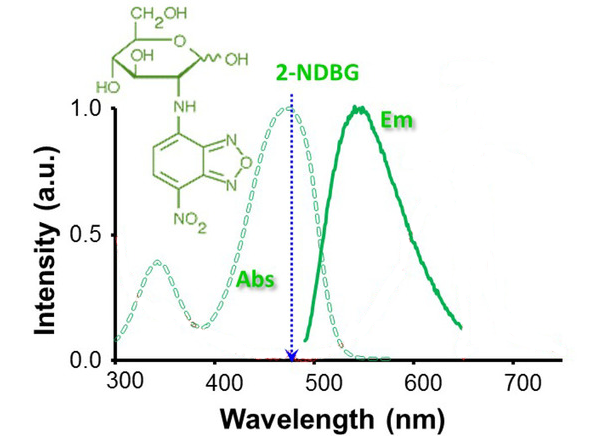
2-NBDG is a fluorescence-labeled 2-deoxy-glucose analog useful as a tracer for evaluation of cellular glucose metabolism (Ex/Em: 475/550 nm).
Glucose is a necessary source of energy for sustaining cell activities and homeostasis in tissues. Glucose metabolism is an important target in many diseases and changed with the pathological condition, therefore, evaluation of glucose metabolism can be a significant indication in disease progressions.
2-NBDG can be used in many kinds of cells in vitro, such as HepG2 human hepatocarcinoma cells, L6 rat skeletal muscle cells, MCF-7 breast cancer epithelial cells and astrocytes, it is also used in disease models, epilepsy rat, hyperglycemia, diabetes or mouse xenograft model of cancer.
2-NBDG enters cells through glucose transporters and is subsequently phosphorylated by hexokinase and trapped inside cells. Flow cytometric detection of fluorescence produced by cells can be performed to examine 2-NBDG uptake into living cells, and the intracellular concentration of transported 2-NBDG can be measured with a fluorescence microplate assay. It can be detected with a fluorescence imaging microscopy or CCD camera simply as well.
2-NBDG is a fluorescently labeled glucose tracer that is transported into cells by the same glucose transporter (GLUT) as glucose. Once 2-NBDG is taken up by cells, it is phosphorylated at the C-6 position to give 2-NBDG-6-phosphate, which is well retained in the cell. Compared to other glucose tracers such as 2-DG or FDG, 2-NBDG enables in situ measurement of 2-NBDG with high temporal and spatial resolution at the single-cell level. (suitable for fluorescence microscopy and flow cytometry detection)
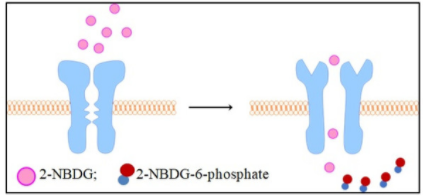
Rationale for 2-NBDG glucose uptake assay in cells: Once 2 NBDG is taken up by cells, it is phosphorylated at the C-6 position to generate 2-NBDG-6-phosphate in 2 NBDG metabolism, which is well retained in the cell, the fluorescence intensity is proportional to the cellular glucose uptake activity.
References:
[1]. Zou C, Wang Y, Shen Z. 2-NBDG as a fluorescent indicator for direct glucose uptake measurement[J]. Journal of biochemical and biophysical methods, 2005, 64(3): 207-215.
[2]. O’Neil R G, Wu L, Mullani N. Uptake of a fluorescent deoxyglucose analog (2-NBDG) in tumor cells[J]. Molecular Imaging and Biology, 2005, 7(6): 388-392.
[3]. Tsytsarev V, Maslov K I, Yao J, et al. In vivo imaging of epileptic activity using 2-NBDG, a fluorescent deoxyglucose analog[J]. Journal of neuroscience methods, 2012, 203(1): 136-140.
[4]. Yan Chen, Junjian Zhang, Xiang-yang Zhang, 2-NBDG as a Marker for Detecting Glucose Uptake in Reactive Astrocytes Exposed to Oxygen-Glucose Deprivation In Vitro. J Mol Neurosci (2015) 55:126–130.
[5]. Tsytsarev V, Maslov K I, Yao J, et al. In vivo imaging of epileptic activity using 2-NBDG, a fluorescent deoxyglucose analog[J]. Journal of neuroscience methods, 2012, 203(1): 136-140.
2-NBDG是一种荧光标记的2-脱氧葡萄糖类似物,可用作细胞葡萄糖代谢评估的示踪剂(激发/发射波长:475/550纳米)。
葡萄糖是维持组织细胞活动和稳态所必需的能量来源。葡萄糖代谢在许多疾病中都是一个重要的靶点,并且会随着病理情况而改变,因此评估葡萄糖代谢可以成为一种重要的指标来判断疾病进展情况。
2-NBDG可以在许多种体外细胞中使用,例如HepG2人类肝癌细胞、L6大鼠骨骼肌细胞、MCF-7乳腺癌上皮细胞和星形胶质细胞,它还用于疾病模型,如癫痫大鼠、高血糖、糖尿病或小鼠异种移植的癌症模型。
2-NBDG通过葡萄糖转运体进入细胞,并被己糖激酶磷酸化并困在细胞内。可以使用流式细胞术检测细胞产生的荧光来检查2-NBDG进入活细胞的情况,也可以使用荧光微孔板分析法测量转运的2-NBDG在细胞内的浓度。它还可以简单地用荧光成像显微镜或CCD相机进行检测。
2-NBDG是一种荧光标记的葡萄糖示踪剂,通过与葡萄糖相同的葡萄糖转运体(GLUT)进入细胞。一旦2-NBDG被细胞吸收,它会在C-6位置磷酸化成为2-NBDG-6-phosphate,并且能够很好地保留在细胞内。与其他葡萄糖示踪剂如2-DG或FDG相比,2-NBDG可以以高时间和空间分辨率在单个细胞水平上原位测量2-NBDG。(适用于荧光显微镜和流式细胞术检测)
2-NBDG葡萄糖摄取实验在细胞中的原理:一旦细胞吸收了2-NBDG,它会在C-6位置被磷酸化,生成2-NBDG-6-磷酸盐,在2 NBDG代谢中很好地保留在细胞内,荧光强度与细胞内葡萄糖摄取活性成正比。