
















4-Methylumbelliferone is a known synthetic inhibitor of hyaluronic acid (HA) [1, 2]. IC50 values are in the proliferation assay were 0.65±0.04mM[3].
4-Methylumbelliferone can inhibit the proliferation of Hepatocellular Carcinoma (HCC) cell lines (0.5mM , 48h) , induce apoptosis (5mM , 48h) , and inhibit the production of HA (Hyaluronan) [4]. Public database analysis predict that 4-Methylumbelliferone stimulated the activity of enzymes , which modulate protein processing (enzymes and transcription factors , including 13 members of the nuclear receptor superfamily regulating lipid and carbohydrate metabolism) , cell motility , membrane glycolipid composition and glycogen breakdown[5].
4-Methylumbelliferone (6.5mg/g/day , 6 months , systemic oral administration) reduced perineuronal nets (PNNs) formation around neurons and enhanced memory retention in mice[6]. 4-Methylumbelliferone (25mg/kg for 24 hours dissolved in DMSO/0.9% NaCl (1 : 4) by intraperitoneal injection) had a potential ability to attenuate the cardiac injury by reducing oxidative stress and inflammation in a TLR4/NF-κB/NLRP3-dependent mechanism[7] .
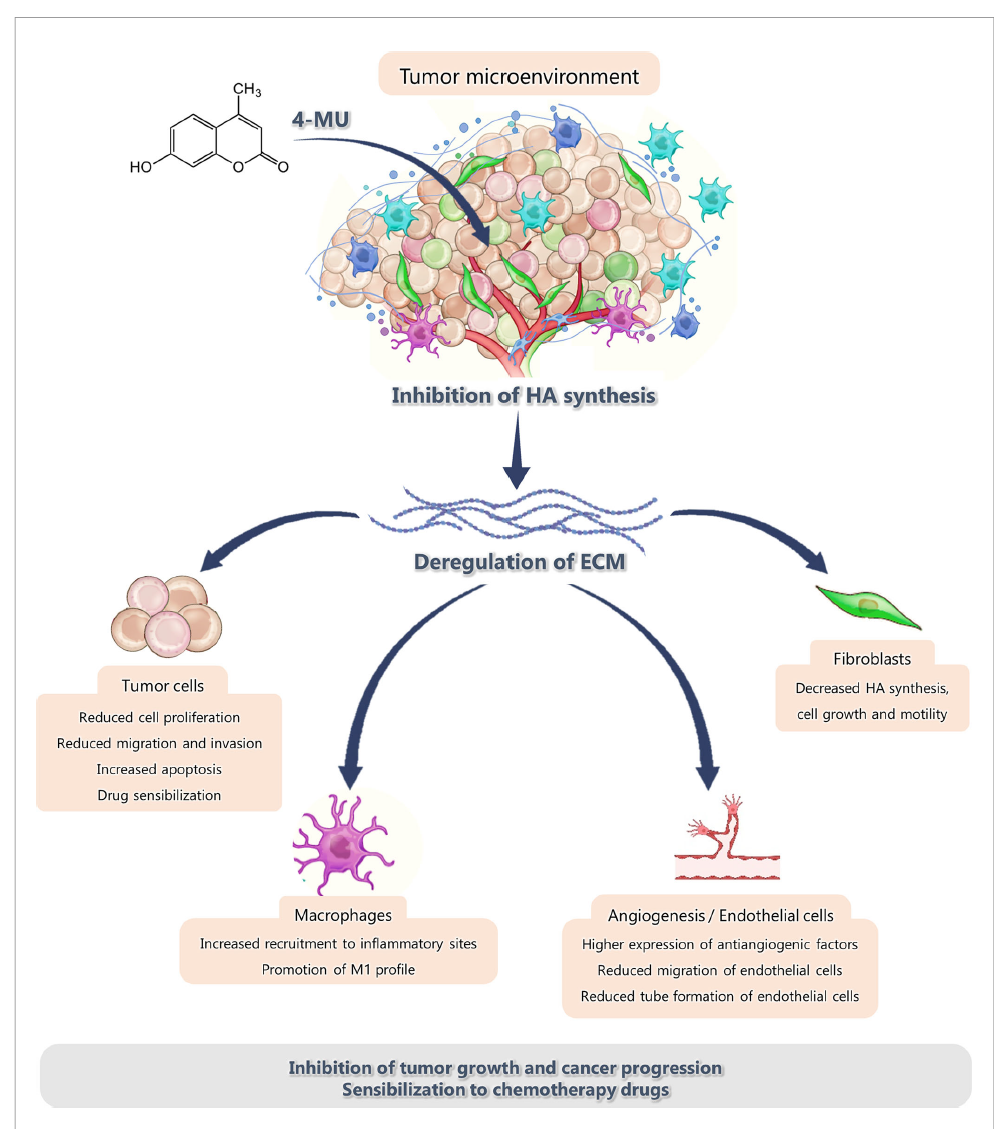
4-Methylumbelliferone deregulates the tumor microenvironment by inhibiting HA synthesis[2].
References:
[1] LUO Y, YANG Z, YU Y, et al. HIF1alpha lactylation enhances KIAA1199 transcription to promote angiogenesis and vasculogenic mimicry in prostate cancer [J]. Int J Biol Macromol, 2022, 222(Pt B): 2225-43.
[2] VITALE D L, ICARDI A, ROSALES P, et al. Targeting the Tumor Extracellular Matrix by the Natural Molecule 4-Methylumbelliferone: A Complementary and Alternative Cancer Therapeutic Strategy [J]. Front Oncol, 2021, 11(710061.
[3] GARCIA-VILAS J A, QUESADA A R, MEDINA M A. 4-methylumbelliferone inhibits angiogenesis in vitro and in vivo [J]. J Agric Food Chem, 2013, 61(17): 4063-71.
[4] PICCIONI F, MALVICINI M, GARCIA M G, et al. Antitumor effects of hyaluronic acid inhibitor 4-methylumbelliferone in an orthotopic hepatocellular carcinoma model in mice [J]. Glycobiology, 2012, 22(3): 400-10.
[5] TSITRINA A A, HALIMANI N, ANDREICHENKO I N, et al. 4-Methylumbelliferone Targets Revealed by Public Data Analysis and Liver Transcriptome Sequencing [J]. International Journal of Molecular Sciences, 2023, 24(3):
[6] JANA DUBISOVA J S B, LUCIE SVOBODOVA , PAVOL MAKOVICKY , NOELIA MARTINEZ-VAREA , ANDA CIMPEAN , JAMES W FAWCETT , JESSICA C F KWOK , SARKA KUBINOVA. Oral treatment of 4-methylumbelliferone reduced perineuronal nets and improved recognition memory in mice [J]. 2022,
[7] BISTOLETTI M, BOSI A, CAON I, et al. Involvement of hyaluronan in the adaptive changes of the rat small intestine neuromuscular function after ischemia/reperfusion injury [J]. Sci Rep, 2020, 10(1): 11521.
4-Methylumbelliferone是一种已知的合成透明质酸(HA)抑制剂[1,2]。增殖试验的IC50值为0.65±0.04mM[3]。
4-Methylumbelliferone可抑制肝细胞癌(HCC)细胞系细胞增殖(0.5mM,48小时),诱导细胞凋亡(5mM,48小时),抑制透明质酸的产生[4]。公共数据库分析预测,4-Methylumbelliferone能够刺激那些调节蛋白质加工(酶和转录因子,包括13个核受体超家族成员调节脂质和碳水化合物代谢)、细胞迁移、膜糖脂构成以及糖原分解的酶的活性[5]。
4-Methylumbelliferone(6.5 mg/g/天,6个月,口服)减少了小鼠神经元周围神经网络(PNNs)的形成,增强了记忆保留[6]。4-Methylumbelliferone(25mg/kg,溶解于DMSO/0.9%NaCl(1:4)中,腹腔注射24小时)通过TLR4/NF-κB/ nlrp53的依赖机制减轻氧化应激和炎症反应,具有减轻心脏损伤的潜在能力[7]。
4- Methylumbelliferone通过抑制透明质酸(HA)的合成来扰乱肿瘤微环境[2]。